How to Experience Theyyam in Kerala: A Respectful Guide to Kannur
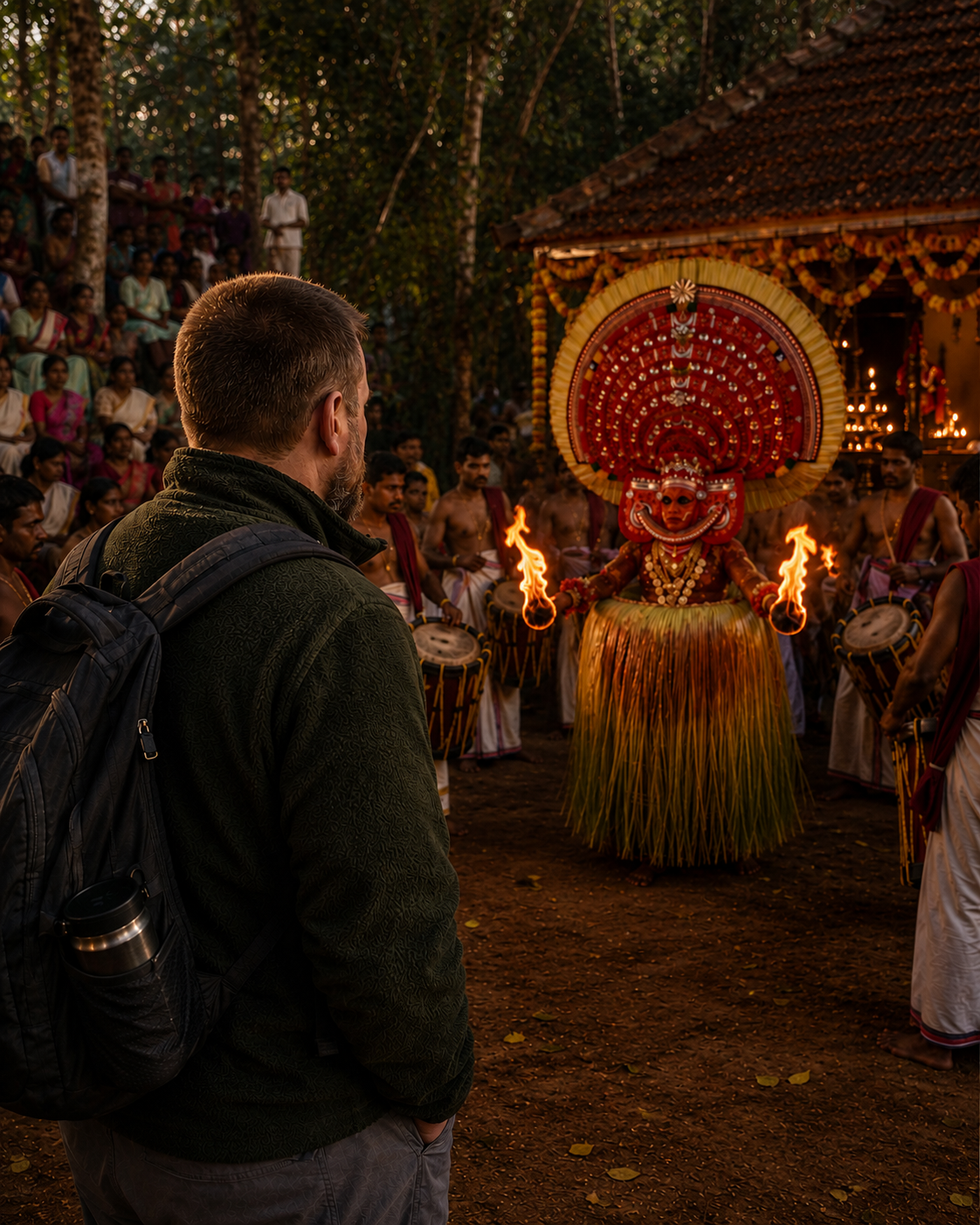
Theyyam is one of the strongest reasons to travel to Kannur and North Malabar, but it is best experienced with local context, patience and respect. Image edited from the author’s own photo.
Theyyam is the strongest reasons to travel to northern Kerala. It is also one of the easiest experiences to misunderstand if you arrive without context. At first, Theyyam can look intensely visual: painted faces, elaborate headpieces, red costumes, drums, fire, movement and a setting that can feel both intimate and overwhelming. But Theyyam is not a performance created for visitors.
It is a living ritual tradition connected to local temples, shrines, sacred groves, families and communities. It belongs to specific places and calendars. It carries religious, social, ecological and cultural meaning. That is why I would be careful with treating Theyyam as just another “thing to do” in Kerala.
For me, Theyyam was one of the most memorable experiences I had in the state. But it also made me very aware of how easily I could have misunderstood it if I had tried to arrange everything on my own. This guide is meant to help you experience Theyyam with more context, more patience and more respect.
Quick answer
The best base for most travellers who want to experience Theyyam is Kannur or the wider North Malabar region in northern Kerala. Theyyam is not something you can simply turn up and see anywhere in Kerala on any day of the year. For most travellers planning around Kannur and North Malabar, December to April is the safest season to work with, but exact dates still depend on local temple and community calendars. If Theyyam is important to your trip, go in season, allow more than one night, confirm the current local schedule and consider going with a knowledgeable local guide.
I experienced Theyyam with Sreejith, the owner of Ekathra Experiences, and he was honestly one of the best guides I have had anywhere in India. He is from the area, knows Theyyam in depth, and helped me understand not only where and when to go, but also what was happening and how to behave respectfully. That context mattered. Theyyam is not hard only because of logistics. It is hard because it is easy to misunderstand.
What Theyyam is — and what it is not
Theyyam is often described as a ritual art form from North Kerala, but that only explains part of it. It is not simply dance, costume or performance. Theyyam is connected to local deities, temples, shrines, sacred groves, families, community memory and village life. In many settings, people are not just watching. They may be seeking blessings, fulfilling vows, taking part in a local ritual calendar or participating in a tradition connected to a specific place.
For a visitor, the first impression may be visual. The face paint, headdress, drums and movement can be powerful. But if you only look at the surface, you miss the point. There are lots of Theyyam forms, and one ritual cannot explain the whole tradition. Different Theyyams may be connected to different deities, stories, families, communities and local histories. That is one reason local context matters so much. You are not seeing a generic cultural show. You are witnessing a ritual form tied to a specific place, deity, community and calendar.
Why Theyyam needs context
I do not think I would have understood Theyyam properly if I had tried to arrange it completely on my own. I experienced it with Sreejith from Ekathra Experiences, and that changed the whole experience. He did not just know where and when to go. He helped me understand what I was seeing, how to behave, when to step back, when photography was appropriate and why the setting mattered. That is very different from simply being taken somewhere to watch something visually impressive.
Theyyam does not always come with signs, explanations or a clear beginning and end for outsiders. You may arrive early, wait, watch people gather, see parts of the preparation from a respectful distance, and slowly understand that the event is not organised around you. Without context, it is easy to reduce Theyyam to colour and spectacle. With context, you begin to understand that the visual side sits inside something deeper: worship, place, memory, community and respect.
Sacred groves, place and ecology
One part of Theyyam that many visitors may not understand at first is its connection to sacred groves, known locally as Kavus. These are not just pretty forest settings. They are sacred landscapes connected to local deities, memory and community life. In some places, they also help protect small pockets of local biodiversity. That connection between ritual and ecology is one of the reasons Theyyam feels so rooted in place.
It does not belong to a stage. It belongs to specific communities, landscapes and calendars. This is also why it matters how you behave. You are not entering a tourist venue. You are entering a local sacred setting, even if it does not look like the formal temple spaces you may be used to.
The social meaning of Theyyam
Theyyam also has a social dimension that should be handled carefully. In some Theyyam traditions, performers come from historically marginalised communities. During the ritual, they may be approached as divine presences and asked for blessings by people from more privileged backgrounds. That does not make Theyyam easy to summarise.
It does not erase wider social inequalities, and it should not be simplified into one neat explanation. But it does show why Theyyam is more than visual culture. It sits at the meeting point of devotion, community, caste, memory and local authority. As an outside visitor, you do not need to understand every layer fully. But you do need to understand enough to avoid treating it as entertainment.
Where to experience Theyyam
For most travellers, Kannur is the easiest and most practical base for experiencing Theyyam. But Theyyam is not limited to Kannur city. The wider North Malabar region is important, including parts of Kannur, Kasaragod and nearby areas. Depending on the local calendar, places around Bekal, Nileswaram or other North Malabar locations may also be relevant.
Still, Kannur works well because it has enough accommodation, transport access and local contacts to make the experience easier to arrange. The important thing is to understand Kannur’s role. Kannur is not necessarily the main attraction in itself. It is the base that helps you reach the right place at the right time with the right context. That is a very different way to think about a destination. You are not going to Kannur because it has a long checklist of famous sights. You are going because it gives you access to a living tradition that is closely tied to the region around it.
When can you see Theyyam?
For practical travel planning around Kannur and North Malabar, December to April is usually the best window for Theyyam. Some local calendars may include events outside this period, but dates vary by temple, shrine and community schedule. This is not something you can simply turn up and see every day of the year.
Online calendars can help you understand the season, but I would not rely on them alone. Dates, times and locations can change, and the best information often comes from someone local who knows the current schedule. If Theyyam is a major reason for your trip, check the timing before you build your route.
I would also avoid planning your entire visit around one possible event. Give yourself flexibility. Theyyam may happen late at night, before dawn or at times that do not fit neatly into a normal sightseeing day. That is part of the experience, but it also means you need to plan realistically.
What you may actually see
No two Theyyam rituals are the same!
Some are small and intimate. Others are louder, longer and more intense. Some take place late at night or before dawn. Some involve fire, large headpieces, elaborate face painting, drums, chanting and long periods of waiting.
For a visitor, the visual side can be the first thing you notice. But the costume, make-up, music and movement are not decoration in the simple sense. They are part of the ritual. The performer may go through preparation before the ritual, including fasting, prayer, discipline and other forms of observance. The headpiece, known as the Mudi, the face painting, the costume and the movements all carry meaning.
You may also hear local terms such as Theyyattam, referring to the ritual performance, or Theyyakolam, referring to the appearance of the deity in costume. In some parts of North Kerala, related traditions may also be referred to as Kaliyattam. You do not need to learn every term before you go. But it helps to understand that Theyyam is not one fixed thing. It has local variation, specific meaning and many forms. That is why the best Theyyam experience is not necessarily the most dramatic one. It is the one you can approach with enough context to understand where you are and what you are witnessing.
Why a local guide makes the difference
A good local guide makes the entire experience more respectful and more meaningful. This is not only about finding the right event. It is about knowing whether visitors are welcome, when to arrive, where to stand, how long to stay, when to be quiet, when photography is acceptable and what the ritual means in that specific place.
I experienced Theyyam with Sreejith, the owner of Ekathra Experiences, and I would recommend him without hesitation. What made him stand out was not just practical knowledge. It was the way he placed the ritual inside a wider cultural context: the temple setting, the community, the role of music, the sacred space, the local calendar and how to behave as an outsider. That matters because Theyyam is not staged around visitors.
There may be no formal explanation. There may be waiting. There may be moments where you are unsure what is happening. There may be times when the most respectful thing is to step back and simply watch. A good guide helps you avoid becoming intrusive.
For me, that was the difference between watching something visually powerful and being guided into a local context with more care.
What makes Theyyam difficult for travellers?
Theyyam is not necessarily difficult because it is expensive or impossible to reach. The difficult part is practical and cultural. You need to know which temple or shrine to go to, confirm the timing, arrange transport at unusual hours, understand where to stand, know when photography is acceptable and remember that the event is not organised around travellers. This is why I would not treat Theyyam like a normal sightseeing activity.
You may need to leave very early or stay out late. You may need to wait. You may not understand everything. The schedule may not be convenient. The most meaningful event may not be the easiest one to reach. That does not mean you should avoid it. It means you should approach it differently.
Theyyam rewards patience more than efficiency.
How many nights do you need?
I would allow at least two nights in or around Kannur if Theyyam is important to you. Three nights is better.
One night can work if the timing is perfect and you have a strong local contact, but it is risky. Theyyam may not happen at the time you expect, or the event that makes most sense for visitors may be outside the city at an inconvenient hour. If you have come all the way to North Kerala for Theyyam, it is worth giving yourself a little space.
A realistic plan would be:
Arrive in Kannur
Allow two or three nights for Theyyam.
Continue south, north or inland depending on your wider route
Do not place Theyyam between two exhausting travel days if you can avoid it.
The experience may involve late nights or early mornings, and you will enjoy it more if you are not rushing straight in or out.
How to behave respectfully
Respect matters more than getting the perfect photo. You are not attending a show. You are entering a local religious and community setting.
Dress modestly.
Do not block local people.
Do not stand in the ritual path.
Do not interrupt the performer, musicians or participants.
Ask before photographing people closely.
Be especially careful with children, families and private moments.
Avoid flash.
Follow local guidance about where to sit or stand.
Accept that you may not understand everything.
Watch how local people behave.
Photography and Theyyam
Theyyam is visually striking, so it is natural to want photographs. Do not assume every moment is yours to capture. Some parts may be more open, while others may feel private, emotional or religiously sensitive. Avoid flash. Keep distance. Do not step into the ritual space for a better angle. Do not make the experience about your camera. If you are unsure, ask your guide or watch what local people are doing.
Sometimes photography is accepted. Sometimes it is better to put the camera away. Some of the most important parts of Theyyam may not be the most photographable ones. That is worth remembering.
What many travellers get wrong
The biggest mistake is treating Theyyam as a performance you can book, consume and leave. That misses the point. Theyyam is not designed around international visitors. It belongs first to local communities. That does not mean travellers should avoid it. Responsible travel does not mean staying away from everything culturally complex. But it does mean you should be careful with how you frame it. It is better to think of it as a living ritual tradition with religious, social and community meaning.
Another mistake is assuming that the most visually dramatic Theyyam is automatically the most meaningful one to attend. For a visitor, the quieter moments may be just as important: the waiting, the gathering, the music, the preparation, the way people move through the space, the way local participants relate to what is happening.
A final mistake is trying to make the experience too convenient. Theyyam is not always convenient. That is part of why you need to adapt to it, rather than expecting it to adapt to you.
How to include Theyyam in a Kerala route
Theyyam works best when you build enough time into the route. It fits naturally into a North Malabar or northern Kerala itinerary, especially if you are travelling through Kannur.
A strong route could look like this:
Bangalore – Mysore – Wayanad – Kannur – Kochi
This gives you a gradual route into Kerala and makes Kannur a natural stop rather than a rushed detour.
You can also include Theyyam as part of a longer Kerala trip, but you need to remember that Kannur is not right next to Kochi, Munnar, the backwaters or Varkala.
Adding Theyyam changes the shape of the route. That may be worth it.
For some travellers, Theyyam is one of the strongest reasons to travel north in Kerala. For others, it may be better to stay with the classic route and save North Malabar for another trip.
The honest question is not “Is Theyyam worth it?”
The better question is: are you willing to give it the time, context and respect it needs?
Practical tips before you go
Check whether you are travelling in Theyyam season.
Do not rely only on old blog posts or general dates.
Confirm current schedules locally.
Use a knowledgeable local guide if Theyyam is important to you.
Allow at least two nights in Kannur.
Be prepared for late nights or early mornings.
Arrange transport in advance.
Keep your plans flexible.
Expect to wait.
Remember that you are a guest.
Final thoughts
Theyyam is not just another Kerala highlight. It is one of the clearest reasons to travel beyond the state’s more familiar route of Kochi, Munnar, backwaters and beaches. But it asks something from you as a traveller. You need time, context and respect. You need to accept that not everything will be arranged around your convenience. You need to understand that you are witnessing something that belongs first to the local community. That is also what makes it powerful.
For me, having Sreejith from Ekathra Experiences as a local guide made all the difference. It turned what could have been a visually impressive but confusing experience into something much more meaningful.
I would not recommend Theyyam to everyone. But for travellers who are curious, patient and willing to approach it properly, it can be one of the most memorable experiences in Kerala.
FAQ
Where is the best place to see Theyyam in Kerala?
Kannur and the wider North Malabar region are usually the best places for travellers to experience Theyyam. Depending on the local calendar, parts of Kasaragod, Bekal, Nileswaram and nearby areas may also be relevant.
Is Theyyam a tourist performance?
No. Theyyam should not be treated as a tourist performance. It is a living ritual tradition connected to local temples, shrines, sacred groves, families and communities.
When is Theyyam season in Kerala?
For practical travel planning around Kannur and North Malabar, December to April is usually the best window for Theyyam. Some local calendars may include events outside this period, but dates vary by temple, shrine and community schedule. Always confirm the current schedule locally before planning your trip around Theyyam.
How many nights do you need in Kannur for Theyyam?
I would allow at least two nights in or around Kannur if Theyyam is important to you. Three nights gives you more flexibility and a better chance of experiencing it without rushing.
Do you need a guide for Theyyam?
In my opinion you need a guide to understand what you see. A knowledgeable local guide can make a major difference. Theyyam is tied to local calendars, sacred spaces and community settings, and a guide can help with timing, etiquette, context and respectful behaviour.
Who is Sreejith from Ekathra Experiences?
Sreejith is the owner of Ekathra Experiences and a local guide from the Kannur/North Kerala region. I experienced Theyyam with him, and he helped me understand the timing, setting, meaning and etiquette of what I was seeing.
Can you take photos of Theyyam?
Photography may be possible in some settings, but it should be done carefully. Avoid flash, keep a respectful distance, do not block local participants and ask before taking close-up photos of people. When in doubt, put the camera away.
Is Theyyam suitable for a first trip to India?
It can be, but it depends on your travel style. Theyyam is best for travellers who are curious, patient and respectful, and who are comfortable with local experiences that may not be fully explained or arranged around visitors.
Is Kannur worth visiting without Theyyam?
Kannur can still be worth visiting for North Malabar food, quieter coastal areas and a different side of Kerala. But for many travellers, Theyyam is the strongest reason to include Kannur in a Kerala route.
How do you include Theyyam in a Kerala itinerary?
Theyyam works well on a route through northern Kerala, such as Bangalore – Mysore – Wayanad – Kannur – Kochi. It can also be added to a longer Kerala trip, but it requires more planning than the classic Kochi, Munnar, backwaters and beach route.
Related guides
If you want to include Theyyam in a wider route, read:
Kerala Beyond the Backwaters: A Route from Bangalore to Kochi
Still deciding where to start in India? Read:
Where Should You Go on Your First Trip to India?
For more route ideas beyond the classic choices, read:
India Beyond the Obvious: 7 Routes That Are Not Just Rajasthan and Goa
