Kerala Beyond the Backwaters: A Route from Bangalore to Kochi
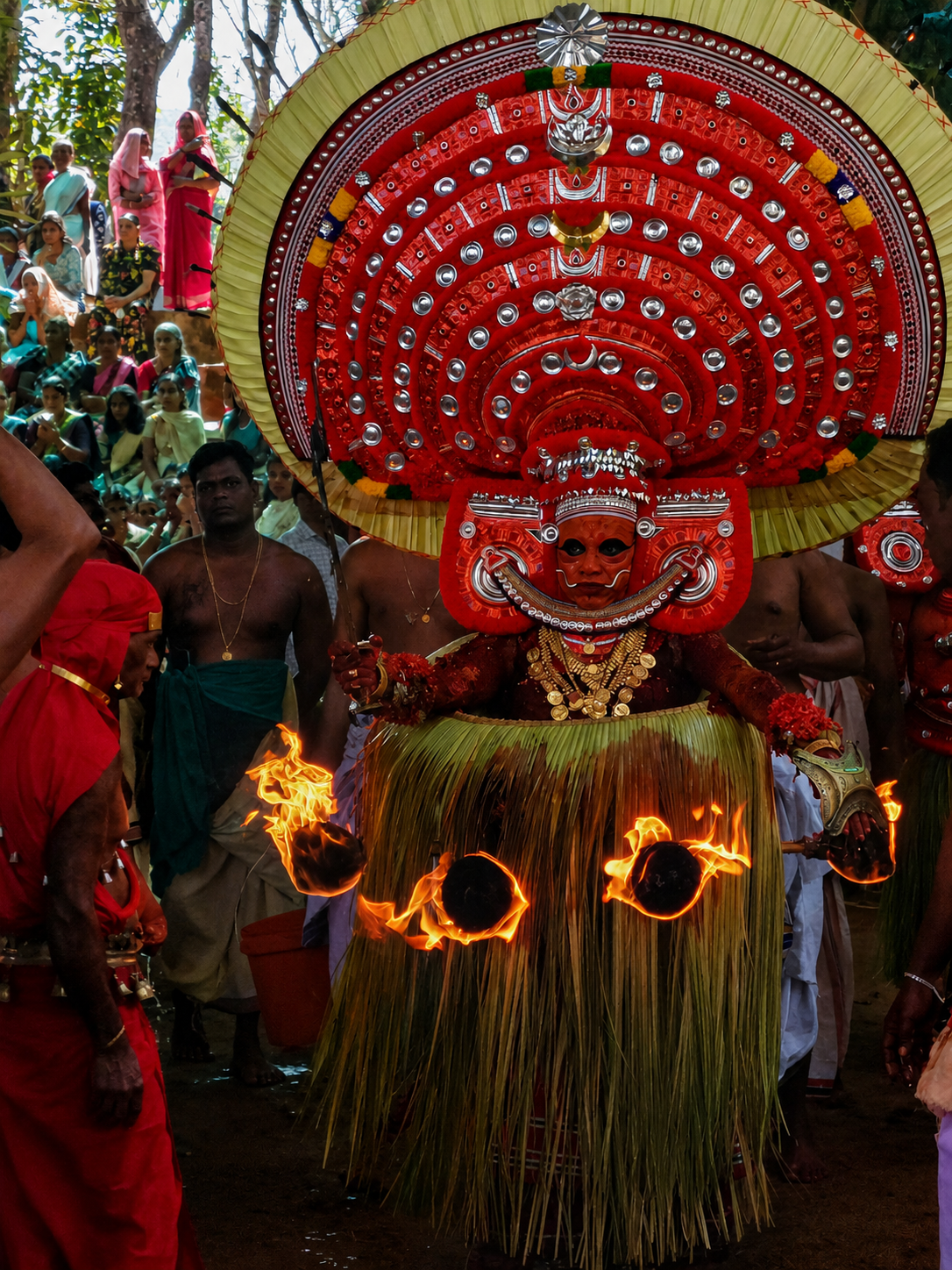
Theyyam is one of the strongest reasons to include Kannur on a route from Bangalore to Kochi, but it is best experienced with local context, patience and respect.
Kerala is often planned in a familiar way: Kochi, the backwaters, Munnar, Periyar, a beach stop and then Trivandrum.
That route can work very well. It gives you old harbour streets, slow waterways, tea hills, spice country and time by the Arabian Sea.
But Kerala does not have to start in Kochi.
One of the more interesting ways to approach the state is to begin further north in Bangalore, in the neighbouring state of Karnataka, and travel overland through Mysore, Wayanad and Kannur before ending in Kochi.
This is not a pure Kerala itinerary from day one. It is better understood as a South India route into Kerala, and that is part of what makes it interesting.
Instead of flying straight into Kochi and following the usual loop, you move gradually from a major South Indian city to Mysore’s palaces and markets, into the hills of Wayanad, across to Kannur for Theyyam and North Malabar, and finally down to Kochi.
For me, this is where the route becomes more than just an alternative to the classic Kerala itinerary. It gives the journey a clearer sense of movement. You are not just visiting Kerala’s most familiar places. You are arriving into the state slowly, through a different door.
Quick answer
A classic Kerala route often looks like this:
Kochi – Backwaters – Munnar – Periyar – Varkala or Kovalam – Trivandrum
A more extended route can look like this:
Bangalore – Mysore – Wayanad – Kannur – Kochi
The second route starts outside Kerala, but it can make sense if you want a more varied journey and a stronger focus on Northern Kerala.
It adds Mysore, the hills of Wayanad, North Malabar food and the chance to experience Theyyam from Kannur. You can end in Kochi and fly home from there, or continue south into the classic Kerala route if you have more time.
The classic Kerala route
A standard Kerala itinerary usually starts in Kochi and moves through some combination of the backwaters, Munnar, Periyar, a beach stop and Trivandrum. It is a good route because it gives you many of Kerala’s best-known landscapes and experiences in a clear order.
Kochi is a soft landing, with old streets, harbour history, galleries, cafes and coastal atmosphere. The backwaters bring canals, boats and slow water travel. Munnar adds tea hills and cooler mountain air. Periyar gives you spice country and access to forested landscapes. Varkala or Kovalam add beach time before flying out of Trivandrum.
I would not argue against this route. For many travellers, especially on a first Kerala trip, it makes a lot of sense.
The point of going beyond the backwaters is not that the classic version is wrong. It is simply not the only way to plan Kerala.
The alternative: Bangalore to Kochi
The alternative route starts in Bangalore and ends in Kochi:
Bangalore – Mysore – Wayanad – Kannur – Kochi
Bangalore and Mysore are in Karnataka, not Kerala. That means this is really a South India route into Kerala rather than a Kerala-only itinerary.
The advantage is that the trip feels more like a journey than a loop. You start inland, move through Mysore, cross into the hills of Wayanad, continue to the North Malabar coast, and end in Kochi.
This shape works especially well if you want Kerala to feel less polished and less predictable than the standard route.
I also like that this route does not try to make every stop equally important. Bangalore is mostly practical. Mysore gives the trip a gentle beginning. Wayanad slows it down. Kannur is there because of Theyyam and North Malabar. Kochi brings the route back to a more familiar Kerala ending or the beginning for the next leg of the journey.
That makes it easier to understand why each stop is there.
Why start in Bangalore?
Bangalore is not the highlight of this itinerary, and I would not pretend that it is. But it is a useful starting point.
It has good flight connections, it gives you access to Mysore, and it opens up a natural overland route towards Wayanad and Northern Kerala.
For many travellers, one night in Bangalore is enough before continuing to Mysore. If you land early morning, you might even go directly to Mysore. The value of starting here is practical: it changes the route and allows Kerala to build gradually rather than beginning immediately in Kochi.
If you are short on time, you do not need to force extra sightseeing into Bangalore. Treat it as the place where the route begins.
Mysore: a gentle start in Karnataka
Mysore is one of the reasons this route works well. It gives the trip a softer beginning after Bangalore, with palace architecture, markets, food, old streets and a more manageable scale.
One or two nights is often enough, but it adds something important to the route. Bangalore to Wayanad in one move can feel like a transfer. Bangalore to Mysore to Wayanad feels more like a journey. Mysore also helps the route feel less like you are simply rushing towards Kerala. You are already travelling, not just moving from airport to destination.
Wayanad: hills, forests and slower travel
Wayanad is where the route starts to feel clearly different from the classic Kerala itinerary. It sits in the Western Ghats and feels greener, hillier and more rural than the coast. The region is spread out, with forests, spice country, waterfalls, viewpoints, small towns and homestays.
This is not a place to rush through with a checklist. Wayanad works best when you allow time for slower days: a short walk, a viewpoint, a drive through forested roads, a plantation visit, a local meal, or simply a quiet stay in the hills.
What I like about Wayanad in this route is that it changes the pace before you reach the coast. It gives the journey a quieter middle section, which is useful before continuing towards Kannur and then Kochi.
The trade-off is that Wayanad is not compact. You need to think about where you stay and how you will get around. Distances inside the region can be longer than they look, and it is easier with a driver or well-planned transport. Wayanad works best as a proper stop, not as a rushed night between Mysore and the coast.
Kannur: a practical base for Theyyam
Kannur is not the kind of place I would build a Kerala route around for the city itself. Its main value is that it works as a practical base for experiencing Theyyam and exploring parts of the North Malabar coast. The city itself can feel fairly ordinary compared with Kerala’s more famous stops. That is not necessarily a problem. On this route, Kannur is less about sightseeing and more about access, timing and context.
For me, Theyyam is the reason Kannur becomes important.
It is one of the experiences that can make Northern Kerala feel very different from the softer, more familiar image many travellers have of the state. But it is also exactly the kind of experience that needs to be approached carefully.
Theyyam should not be treated as a tourist show. It is a ritual tradition connected to local temples, shrines, families and community life in North Malabar. Some events take place late at night or early in the morning, and the atmosphere can be intense, intimate and very local. If you are interested in Theyyam, stay in or around Kannur rather than trying to visit as a rushed day trip from somewhere else.
A good local contact or guide can make a real difference here. It’s simply a must, because they are difficult to find, if you don’t know how. I experienced Theyyam with Sreejith, the owner of Ekathra Experiences, and he was honestly one of the best guides I have had anywhere in India. He is from the area, knows Theyyam in depth, and helped me understand not only where and when to go, but also what was happening and how to behave respectfully. I recommend contacting Ekathra Experiences directly if you want help arranging Theyyam around Kannur.
That context mattered. Theyyam events are tied to local temples, shrines, families and community calendars. The experience depends heavily on when you are there, where you go and how much you understand before you arrive. If you go, approach it with patience and respect. Be careful with photography, do not get in the way, and remember that you are a guest in a living cultural and religious setting. If Theyyam is important to you, give Kannur more than one night. The point is not to tick off a performance. The point is to give yourself enough time to experience it properly, with local context.
North Malabar beyond Theyyam
Theyyam may be the strongest reason to include Kannur, but the route should not depend only on one event.
North Malabar also gives you a different coastal Kerala from the more familiar beach stops further south.
The beaches around Kannur can be quieter and less polished than places like Varkala or Kovalam. The food is another reason to spend time here, especially if you are interested in Malabar cooking, seafood, biryani and regional flavours that feel different from central and southern Kerala.
I would not frame Kannur as a beach destination in the same way as Varkala. That creates the wrong expectation.
It works better if you think of it as a practical and cultural stop: a base for Theyyam, a way into North Malabar, and a place to experience a different coastal rhythm before the route continues to Kochi.
This part of the route is more about timing, food, local context and atmosphere than easy sightseeing.
Kochi: where the route comes back to classic Kerala
Ending in Kochi gives the route a natural landing point.
After Bangalore, Mysore, Wayanad and Kannur, Kochi brings you back into the more familiar Kerala travel circuit. It is also practical, with an international airport and good onward connections.
Fort Kochi has old streets, galleries, cafes, churches, synagogues, markets and harbour history. It is not the whole of Kochi, or the whole of Kerala, but it is one of the easiest places in the state to slow down for a day or two before flying home.
This is one reason I like Kochi as the end point of the shorter version. You do not have to force the route all the way to Trivandrum for it to feel complete.
You can finish in Kochi and still have a route that makes sense.
Should you stop in Kochi or continue south?
If you have around 10 days, end in Kochi.
A realistic 10-day route could look like this:
Bangalore – Mysore – Wayanad – Kannur – Kochi
If you have three weeks or more, you can continue south into the classic Kerala route:
Bangalore – Mysore – Wayanad – Kannur – Kochi – Munnar – Periyar – Backwaters – Varkala or Kovalam – Trivandrum
This longer route only works if you do not rush it. If you try to include everything in too little time, the trip will become tiring.
A better approach is to decide whether the Bangalore-to-Kochi route is your full trip or the first half of a longer Kerala itinerary.
I would be careful with adding too much just because the places look close enough on a map. Kerala is not huge compared with India as a whole, but the route can still feel busy if you keep moving every day or two.
How much time do you need?
For the Bangalore-to-Kochi route, I would allow around 10 days.
A balanced version could look like this:
Bangalore: 1 night (Depending on arrival time)
Mysore: 2 nights
Wayanad: 3 nights
Kannur: 2 or 3 nights
Kochi: 2 nights
That gives you enough time to move at a realistic pace, especially if Theyyam is part of your reason for staying in Kannur.
If you only have a week, the route is possible but tight. You would need to cut something or accept that the trip will feel more like a fast overland route than a slower Kerala journey.
If you have two weeks, you can slow down or continue south from Kochi.
For the longer version ending in Trivandrum, I would allow at least 18 days, and preferably closer to three weeks if you want it to feel relaxed.
Best time for this route
The best time for this route depends on both weather and Theyyam.
For many travellers, the most comfortable time to visit Kerala and Karnataka is during the cooler, drier months from roughly November to February.
This is also a good starting point if Theyyam is important to you.
Theyyam season is generally associated with the cooler months in North Malabar, often running from around October or November into spring, depending on the specific temple and local calendar.
Dates, timings and locations vary. Before booking around Theyyam, check current local schedules with reliable sources in Kannur, such as local guides, accommodations or people who know the temple calendars.
The monsoon can make Kerala very green and atmospheric, but it also changes the route. Heavy rain can affect roads, outdoor plans, beach time and hill travel.
If Theyyam is one of your main reasons for choosing this route, I would not leave the timing vague. Plan Kannur around actual local information, not just a general idea of the season.
Practical trade-offs
This route is rewarding, but it is not the simplest Kerala itinerary.
It starts outside Kerala, so it takes a little more explanation and planning than a standard Kochi-based route.
Transport also matters. Bangalore, Mysore, Wayanad, Kannur and Kochi can connect well, but you still need to think carefully about transfers, road time and where it makes sense to stay.
Kannur is another trade-off. The city is useful, but not the main attraction in itself. Its value comes from being a base for Theyyam, North Malabar food and parts of the coast.
Finally, this route asks you to choose. If you start in Bangalore and include Mysore, Wayanad and Kannur, you may need to skip or shorten some classic Kerala stops unless you have more time.
That is not a weakness. It is just realistic planning.
Final thoughts
Kerala is often reduced to backwaters, beaches and tea hills. Those places can be worth visiting, but they are not the only way to understand the state.
A route from Bangalore to Kochi gives Kerala a different shape. It starts in Karnataka, moves through Mysore, crosses into the hills of Wayanad, uses Kannur as a base for Theyyam and North Malabar, and ends in Kochi.
What I like about this route is that it does not try to replace the classic Kerala itinerary. It simply approaches Kerala from another direction.
It is not the easiest Kerala route, and it is not the most standard. But if you have enough time and want more variety, more regional context and a less obvious way into Kerala, it is one of the strongest alternatives to consider.
FAQ
Is Bangalore in Kerala?
No. Bangalore is in Karnataka, not Kerala. This route starts in Karnataka and then travels into Kerala through Mysore, Wayanad and Kannur before ending in Kochi.
Is this a Kerala itinerary or a South India itinerary?
It is best understood as a South India route into Kerala. Kerala is still the main focus, but the journey starts in Karnataka, which gives the route more variety and a more gradual build-up.
What is the route from Bangalore to Kochi?
A practical route is Bangalore – Mysore – Wayanad – Kannur – Kochi. This connects Karnataka, the hills of northern Kerala, North Malabar and finally Kochi.
Why include Kannur in this route?
Kannur makes sense mainly as a practical base for Theyyam and parts of the North Malabar coast. The city itself is not the main reason to go, but it can be useful if you want to experience Theyyam with the right timing and local context.
What is Theyyam?
Theyyam is a ritual tradition connected to temples, shrines, families and communities in North Malabar, especially in northern Kerala. It involves elaborate costume, music, movement and religious meaning, and it should be approached with respect rather than treated as a tourist performance.
When can you see Theyyam in Kerala?
Theyyam is generally associated with the cooler season, often from around October or November into spring, but dates and locations vary by temple and local calendar. Always check current local schedules before planning your route around it.
How many days do you need from Bangalore to Kochi?
Around 10 days is a realistic minimum for Bangalore – Mysore – Wayanad – Kannur – Kochi. If you want to continue south to Munnar, Periyar, the backwaters, a beach stop and Trivandrum, you need at least 16 to 18 days, and preferably longer.
Should you end in Kochi or Trivandrum?
End in Kochi if you want the shorter version of the route from Bangalore through Wayanad and Kannur. Continue to Trivandrum if you want to add the classic Kerala route with Munnar, Periyar, backwaters and a beach stop such as Varkala or Kovalam.
Related guides
Still deciding where to start in India? Read:
Where Should You Go on Your First Trip to India?
For more route ideas beyond the classic choices, read:
India Beyond the Obvious: 7 Routes That Are Not Just Rajasthan and Goa
If you are choosing between different parts of the country, read:
North India or South India: Which Should You Visit First?
If you want to know more about Theyyam, read:
How to Experience Theyyam in Kerala: A Respectful Guide to Kannur
