From Kolkata to the Himalayas: A Route Through Eastern India
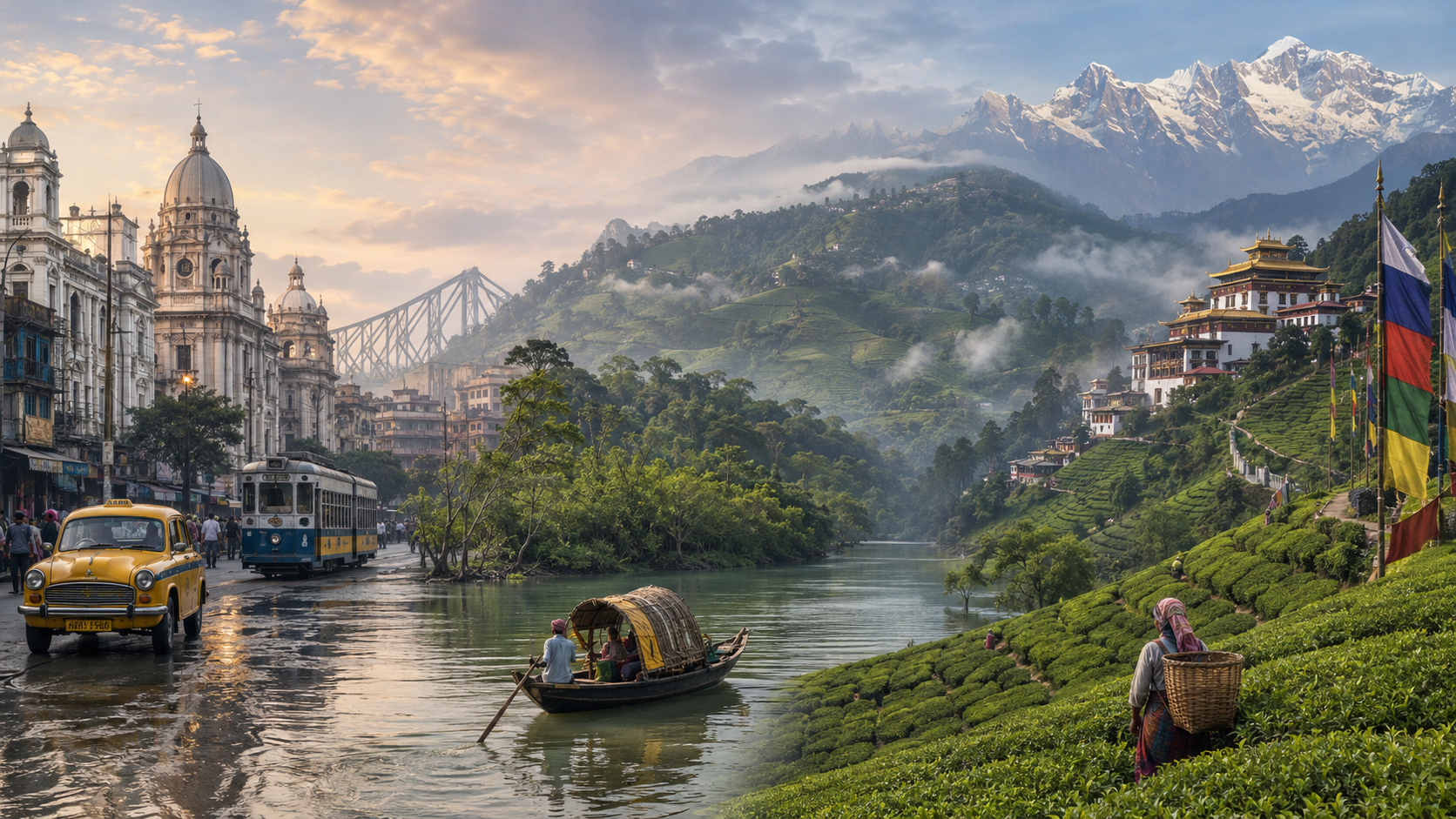
An Eastern India route can move from Kolkata’s city life to the river landscapes of the Sundarbans, the tea hills of Darjeeling and the Himalayan culture of Sikkim. AI-assisted illustration.
If you want a route that feels different from the standard Golden Triangle or Kerala itinerary, eastern India is worth considering. A journey from Kolkata to the Sundarbans and Darjeeling gives you a very different kind of India trip: city life, river landscapes, mangroves, tea hills and the foothills of the Himalayas.
For me, the strength of this route is the contrast.
You begin in Kolkata, one of India’s most layered cities. You move into the waterways and mangroves of the Sundarbans. Then you travel north towards Darjeeling, where the landscape changes again into tea hills, cooler air and Himalayan views. After Darjeeling, you can shape the route in different ways. You can keep it simple with Kalimpong, continue into Sikkim with Gangtok, or add hiking or trekking if the mountains are a main reason for your trip.
This is not the easiest India route. Transport takes planning, weather matters, and the mountain section should not be rushed. But if you want a route with clear movement and real regional contrast, Kolkata to the Himalayas is one of the most interesting ways to go beyond the obvious.
Quick answer
A realistic eastern India route could look like this:
Kolkata – Sundarbans – Kolkata – Darjeeling – Kalimpong or Gangtok – Bagdogra
Kolkata, the Sundarbans and Darjeeling are the core of the route. They give the trip its strongest contrast: city life, delta landscapes and tea hills. After Darjeeling, you can choose how to end the mountain section:
Choose Kalimpong if you want a calmer and simpler hill-town ending.
Choose Gangtok if you want more Himalayan culture and a stronger Sikkim element.
Choose hiking or trekking if you want the route to become more active. Singalila Ridge is one of the best-known longer trekking options in the Darjeeling area, but it is not the only way to spend time in the hills. Longer trekking is not for everyone, and it should be planned as a real part of the route rather than added casually.
If you have around two weeks, keep the mountain section fairly simple. If you have closer to three weeks, you can add more depth: more time in Sikkim, more hiking, or a longer trek.
Who this route is for
This route is for travellers who want to see a different side of India. It works especially well if you are interested in cities, food, river landscapes, mangroves, tea hills, mountain culture and slower overland travel. It can work for a first trip to India, but only if you are comfortable with a route that is slightly less straightforward than Delhi, Agra and Rajasthan or a classic Kerala itinerary. I would not choose this route if you want the easiest possible first trip. I also would not choose it if your main dream is forts, palaces, beaches or big-name monuments.
This route is better for travellers who are curious about regional differences and do not mind that some of the best parts of the trip take time to reach.
Why start in Kolkata?
Kolkata is one of the strongest reasons to choose this route. It is a major Indian city, but it feels different from Delhi or Mumbai. There is history, food, old colonial architecture, markets, literature, street life, riverfronts and a slower rhythm than many travellers expect from a large Indian city. Kolkata is not always polished, and it can feel intense when you first arrive like most other major city in India, but it is also one of India’s most interesting cities if you give it time. I would not treat Kolkata as a quick transit stop on this route. It deserves at least two or three nights, especially if this is your first time in eastern India.
A few things that make Kolkata worth your time:
Old neighbourhoods and colonial-era architecture
Markets and street food
The Hooghly riverfront
Kumartuli, if visited respectfully
Bookshops, cafes and cultural institutions
A slower, layered city atmosphere
The trade-off is that Kolkata is still a large Indian city. It can be hot, busy and chaotic. If you arrive expecting a gentle introduction, you may need a day to adjust. But as the starting point for an eastern India route, it makes sense. It gives the trip weight before you move into the delta and the hills.
Why the Sundarbans matter
I would absolutely include the Sundarbans on this route. Without the Sundarbans, the journey becomes more of a Kolkata-to-Darjeeling mountain route. That can still be a good trip, but it loses some of the contrast that makes eastern India so interesting. The Sundarbans give the route a completely different layer before you head north: rivers, mangroves, boats, islands, birds, tides and delta landscapes.
This is not a simple wildlife stop where you go for guaranteed tiger sightings. The experience is more about atmosphere, landscape and the feeling of moving through a vast watery region than about ticking off animals. That does not make the Sundarbans less worthwhile. It just means you need the right expectations. After Kolkata’s streets and traffic, the waterways feel like a real shift in pace. You move more slowly, spend time on boats, and see a side of Bengal that feels far removed from both the city and the mountains.
The trade-off is time. A rushed one-night trip can feel like a lot of transport for a short experience. If you include the Sundarbans, I would usually allow at least two nights, or be very clear about why you are going. For me, the Sundarbans are what make this route feel like more than a Himalayan add-on. They are part of the route’s identity.
Getting from Kolkata to Darjeeling
The most practical way to travel from Kolkata towards Darjeeling is usually by train to New Jalpaiguri, followed by road travel into the hills. You can fly to Bagdogra, if you want. Personally I prefer the train.
The Vande Bharat Express from Howrah to New Jalpaiguri makes this section much easier to understand. It is a daytime train, leaving Kolkata early in the morning and arriving at New Jalpaiguri in the early afternoon. From New Jalpaiguri, you continue by road towards Darjeeling, Kalimpong or Sikkim. That makes the journey feel less like a difficult long-distance transfer and more like a clear travel day: train first, then mountain road.
A realistic way to plan this part would be:
Kolkata – Vande Bharat Express to New Jalpaiguri – road transfer to Darjeeling
Or, if you want to avoid a very long combined day:
Kolkata – Vande Bharat Express to New Jalpaiguri – overnight near Siliguri or New Jalpaiguri – Darjeeling the next morning
For most travellers, I would only stay in Siliguri or New Jalpaiguri for practical reasons. They are useful gateways, not the main point of the trip.
Before booking, check current train schedules, operating days, ticket availability and road conditions into the hills.
Darjeeling: tea hills, views and realistic expectations
Darjeeling is one of the best-known hill stations in India, and it has a strong image: tea plantations, mountain views, old colonial-era buildings and glimpses of Kangchenjunga on clear days. It can be beautiful. It can also be busy, built-up and more crowded than some travellers expect. That is the honest trade-off with Darjeeling.
You should not come expecting a quiet mountain village. Darjeeling is a real town, with traffic, shops, hotels, weather changes and crowds in peak periods. But it still has atmosphere, especially if you slow down and do not treat it only as a viewpoint. Darjeeling works well in this route because it marks the shift from lowland Bengal into the hills. After Kolkata and the Sundarbans, the cooler air and tea landscapes feel like a real change.
Things Darjeeling can offer:
Tea estates and hill scenery
Views of Kangchenjunga in clear weather
The Darjeeling Himalayan Railway
Old hill-station atmosphere
Walkable streets and viewpoints
A base before continuing into Kalimpong, Sikkim or trekking country
I would give Darjeeling at least two nights. Three is better if you want a slower pace or if mountain views matter to you, because the weather can easily hide them. The biggest mistake is expecting every day to be clear and scenic. In the Himalayas, weather is part of the route, not a detail.
Hiking and trekking around Darjeeling
Darjeeling does not have to be only tea estates, viewpoints and town walks.
If you enjoy hiking, the surrounding hills can add a more active layer to this route. There are shorter walks, day hikes and longer trekking options in the region, depending on your time, fitness, season and how much you want the mountain part of the trip to shape the itinerary. For many travellers, a shorter hike or a slower day in the tea hills may be enough. You still get closer to the landscape without turning the route into a trekking trip.
If you want something more serious, the Singalila Ridge Trek is one of the best-known options from the Darjeeling area. It usually starts from Manebhanjan, within reach of Darjeeling, and follows a ridge near the India–Nepal border with views towards Kangchenjunga in clear weather.
But Singalila Ridge is not the only way to make this route more active, and longer trekking is not for everyone. You need extra days, reasonable fitness, suitable weather and a willingness to accept simpler accommodation and less predictable mountain conditions. That is why I would treat trekking as an optional layer, not as a fixed part of the route.
The core of this itinerary is Kolkata, the Sundarbans and Darjeeling. After that, you can decide whether the mountain section should be about hiking, Sikkim, Kalimpong, or simply slowing down in the hills.
Kalimpong, Pelling or Gangtok: how to choose
After Darjeeling, the route can go in a few different directions.
Kalimpong is the easier choice. It gives the route a calmer hill-town stop after Darjeeling, with monasteries, markets, viewpoints and a slower rhythm. It is not necessarily the most dramatic place in the region, but that can be part of the appeal. I would choose Kalimpong if you want the route to stay manageable and less tiring.
Pelling is the more scenic choice. It can offer a stronger sense of the Himalayas and, in clear weather, views towards Kangchenjunga. The trade-off is that it adds more road time and makes the route feel more ambitious. I would choose Pelling if mountain views are a priority and you have enough time to avoid rushing.
Gangtok is the practical Sikkim base. It is not the quiet mountain town some travellers imagine, but it works well for access, infrastructure, monasteries, viewpoints and possible day trips further into Sikkim. I would choose Gangtok if you want a realistic introduction to Sikkim and are comfortable with a slightly more complex mountain section.
A simple way to decide is this:
Choose Kalimpong if you want the route to stay calm and manageable.
Choose Pelling if you want stronger mountain scenery and have more time.
Choose Gangtok if you want Sikkim culture, monasteries and a more developed base for onward travel.
You do not need to include all three. In most cases, one or two of them is enough.
Sikkim: where the route changes
Sikkim gives this route a different character. Compared with Kolkata, the Sundarbans and Darjeeling, Sikkim feels like another layer of India again: mountain roads, monasteries, Buddhist culture, different food, different architecture and a strong sense of regional identity.
Gangtok is the most common base, and it works well logistically. From there, travellers often consider places such as Rumtek, Tsomgo Lake, North Sikkim, West Sikkim or other mountain areas depending on time, access and current conditions. But Sikkim needs more care in planning than many travellers realise. Some areas require permits. Weather can affect roads. Distances can feel short on a map and long in reality. Mountain travel is slower, and routes can change depending on the season, landslides or local restrictions.
That does not mean Sikkim is too difficult. It just means you should not add it casually. I would treat Sikkim as one possible mountain ending to the route, not something you have to force in. If you only have time for a short visit, Gangtok and a nearby day trip may be enough. If you want to go deeper into Sikkim, you need more days and more flexibility.
Before planning, always check current permit rules, road conditions and local advice for the specific areas you want to visit.
How much time do you need?
You can do a shorter version of this route in around 10 days, but it will feel selective. A better timeframe is around two weeks.
With 10 days, I would keep the mountain section simple.
A realistic 10-day version could look like this:
Kolkata – Sundarbans – Kolkata – Darjeeling – Kalimpong – Bagdogra
With around two weeks, the route becomes more comfortable:
Kolkata – Sundarbans – Kolkata – Darjeeling – Kalimpong or Gangtok – Bagdogra
With closer to three weeks, you can add more depth:
Kolkata – Sundarbans – Kolkata – Darjeeling – hiking or trekking – Kalimpong – Gangtok – Bagdogra
or
Kolkata – Sundarbans – Kolkata – Darjeeling – Pelling – Gangtok – Bagdogra
The important thing is not to treat every option as essential.
Kolkata, the Sundarbans and Darjeeling are the core. After that, choose the mountain ending that fits your time, energy and interests.
Best time for this route
The best time depends on what matters most to you.
For Kolkata and the Sundarbans, the cooler months are generally more comfortable than the hottest part of the year. For Darjeeling and Sikkim, visibility, rain and road conditions matter a lot.
A good general window for this route is often autumn or spring, when the weather can be more comfortable and mountain visibility may be better.
Winter can work, especially for Kolkata and lower hill areas, but higher mountain routes may be colder or more restricted.
The monsoon can make the region green and atmospheric, but it also brings rain, clouds, landslide risk and more uncertainty in the hills.
If Himalayan views or trekking are important to you, do not treat season as an afterthought. Weather can shape the whole experience.
Before booking, check current conditions for Kolkata, the Sundarbans, Darjeeling and the specific parts of Sikkim or the hills you plan to visit.
Practical trade-offs
This route is rewarding, but it is not effortless.
The first trade-off is transport. Kolkata, the Sundarbans, Darjeeling and the Sikkim hills connect logically, but not always quickly. You will need to think about trains, road transfers and overnight stops.
The second trade-off is weather. In the mountains, views are never guaranteed. Clouds, rain and road conditions can affect the experience.
The third trade-off is complexity. Sikkim can involve permits and local restrictions, especially if you want to visit areas beyond the simplest routes.
The fourth trade-off is choice. After Darjeeling, you need to decide what kind of mountain ending you want. Kalimpong, Gangtok, Pelling and trekking all pull the route in slightly different directions.
For me, this route works best when you accept that it needs time. It is not a checklist route. It is a route of transitions. The mistake would be trying to include Kolkata, Sundarbans, Darjeeling, Kalimpong, Pelling, Gangtok and a trek all in one short trip. That may look exciting on paper, but it will probably feel rushed in real life.
Final thoughts
A route from Kolkata to the Himalayas is not the obvious first India itinerary. That is exactly why it can be interesting.
The strongest version begins in Kolkata, moves into the river landscapes of the Sundarbans, and then climbs towards Darjeeling’s tea hills and Himalayan foothills. After that, you can choose your ending.
Keep it calm with Kalimpong. Make it more cultural with Gangtok and Sikkim. Make it more active with hiking or trekking from the Darjeeling area.
The route does not need one perfect version. Its strength is that the core is clear, while the mountain ending can be shaped around the kind of trip you actually want.
I would choose this route if you want India to feel varied, regional and less predictable than the classic highlights. I would not choose it if you want the simplest first trip or if you are trying to see as much as possible in too little time.
Done well, this is not just a route from a city to the mountains. It is one of the most interesting ways to understand how different one part of India can feel from another.
FAQ
Is Kolkata a good place to start an India trip?
Kolkata can be a good place to start if you are interested in history, food, markets, old neighbourhoods and a different kind of Indian city experience. It is not the softest arrival point, but it is one of the most interesting cities in India if you give it time.
Should you include the Sundarbans on this route?
Yes, I would include the Sundarbans. They give the route an important contrast between Kolkata’s city life and the Himalayan foothills around Darjeeling. The Sundarbans are not about guaranteed tiger sightings, but about rivers, mangroves, boats, islands and delta landscapes.
How do you travel from Kolkata to Darjeeling?
A practical option is to take the Vande Bharat Express from Howrah to New Jalpaiguri, then continue by road into the hills towards Darjeeling. Check current train schedules, operating days and road conditions before booking.
How many days do you need for Kolkata, Sundarbans and Darjeeling?
Around 10 days can work for a shorter route focused on Kolkata, the Sundarbans and Darjeeling. Around two weeks is better if you want to add Kalimpong or Gangtok. With closer to three weeks, you can add more hiking, trekking or a deeper Sikkim section.
Should I choose Kalimpong or Gangtok?
Choose Kalimpong if you want a calmer and simpler hill-town stop after Darjeeling. Choose Gangtok if you want a stronger Sikkim element, with monasteries, mountain roads and a different regional atmosphere.
Is Pelling worth adding?
Pelling can be worth adding if Himalayan views are a priority and you have enough time for extra road travel. It is a more ambitious choice than Kalimpong and should not be squeezed into a rushed route.
Can you go hiking from Darjeeling?
Yes. Darjeeling can be used for shorter walks and day hikes in the surrounding hills, and there are longer trekking options in the region. Singalila Ridge is one of the best-known treks from the Darjeeling area, usually starting from Manebhanjan, but it should be planned properly.
Should you add the Singalila Ridge Trek to this route?
Add the Singalila Ridge Trek if hiking is a real priority and you have enough extra days. I would not add it casually to an already full itinerary. It can be a strong choice, but it changes the pace and focus of the mountain section.
Do you need permits for Sikkim?
Some parts of Sikkim may require permits, especially for foreign travellers or for areas beyond the simplest routes. Rules can change, so check current permit requirements and local advice before planning your route.
What is the best time to travel from Kolkata to Darjeeling and Sikkim?
Autumn and spring are often good times to consider because the weather may be more comfortable and mountain visibility can be better. Winter can work for some areas, while the monsoon brings more rain and uncertainty, especially in the hills. Always check current local conditions before booking.
Is this route good for a first trip to India?
It can be, but it is not the easiest first India route. It is better for travellers who are comfortable with more planning and want something less standard than Rajasthan, Goa or Kerala.
What is the main trade-off of this route?
The main trade-off is logistics. The route is varied and rewarding, but transport, weather, mountain roads, possible permits and optional trekking plans all need more planning than a simple city-to-city itinerary.
Can you fly from Sikkim?
Sikkim has an airport at Pakyong, near Gangtok, but I would not build this route around it unless flights are clearly operating reliably at the time of travel. For most travellers, Bagdogra is still the safer planning choice for leaving Darjeeling or Sikkim. That means a longer road transfer, but it is usually easier to plan around. If Pakyong flights are operating when you travel, they may be worth checking. I would treat them as a bonus option, not the backbone of the itinerary.
Related guides
Still deciding where to start in India? Read:
Where Should You Go on Your First Trip to India?
For more route ideas beyond the classic choices, read:
India Beyond the Obvious: 7 Routes That Are Not Just Rajasthan and Goa
If you are choosing between different parts of the country, read:
