Gujarat or Rajasthan: Which Western India Route Should You Choose?
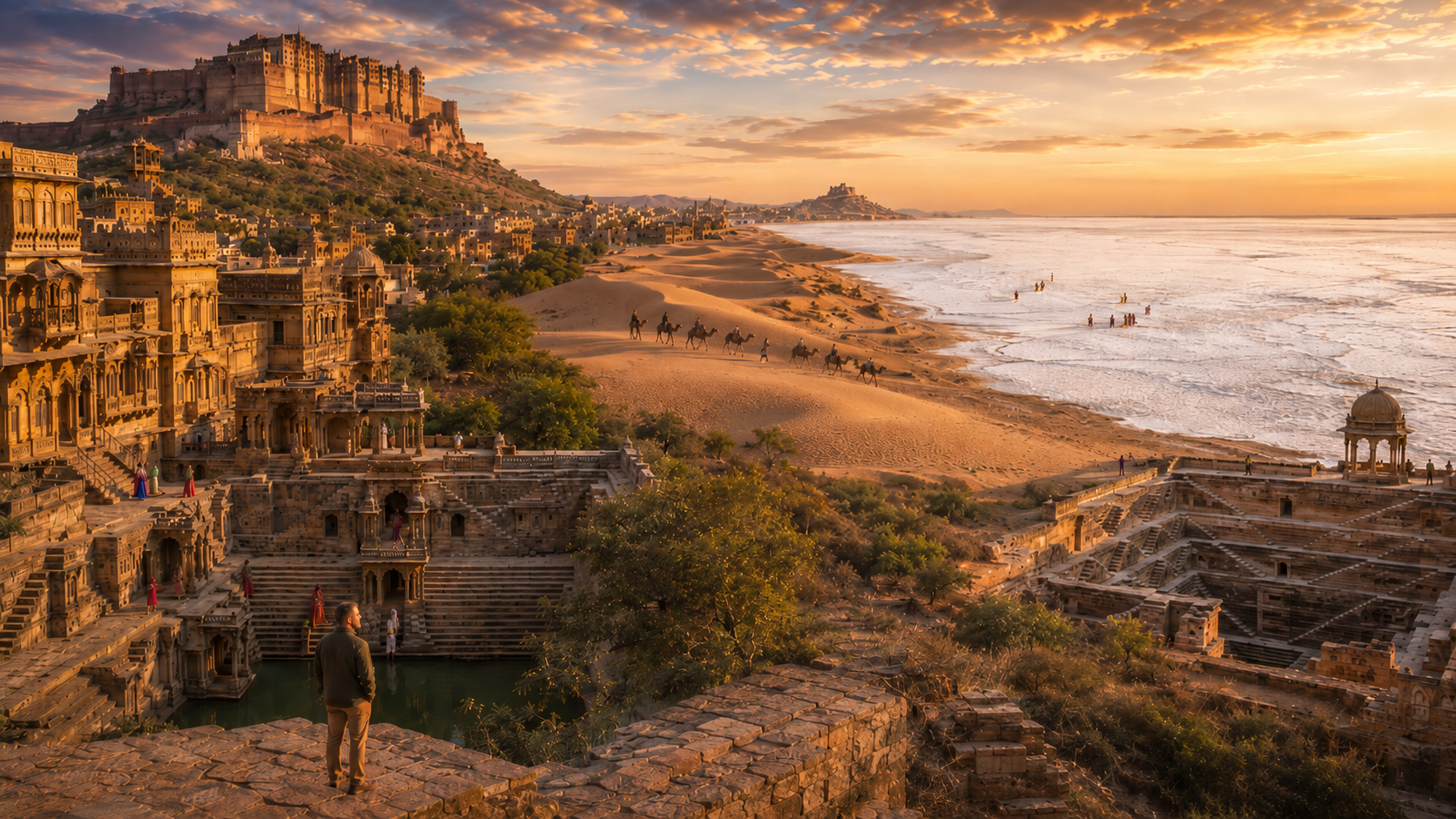
Rajasthan is the classic western India choice, but Gujarat offers a less obvious route through stepwells, salt landscapes, temples and longer distances. AI-assisted illustration.
Rajasthan is one of the most obvious choices for a trip to India. Gujarat is not.
That difference alone shapes how many travellers think about western India. Rajasthan is easier to imagine: forts, palaces, desert cities, old streets, lake views and a very established travel route. Gujarat is less familiar, more spread out and harder to summarise in one simple image.
But that does not make Gujarat less interesting. It just makes it a different kind of trip.
If you are choosing between Rajasthan and Gujarat, the question is not which state is better. The better question is: what kind of western India route do you actually want?
Do you want the classic version, with easier logistics and famous sights? Or do you want a less standard route with stepwells, textiles, salt desert landscapes, Jain temples, coastal towns and Asiatic lions?
This guide is meant to help you choose the route that fits your time, interests and comfort level.
Quick answer
Choose Rajasthan if you want the classic western India route: forts, palaces, desert cities, historic hotels, easier planning and a strong first impression.
Choose Gujarat if you want a less obvious route with stepwells, textiles, craft villages, salt desert landscapes, Jain temples, coastal towns and wildlife.
Rajasthan is usually easier for a first trip to India. The route is more established, the sights are more famous, and it is easier to build a two-week itinerary that feels clear.
Gujarat is better if you have already visited India before, or if you are comfortable choosing a route that is less shaped by the standard tourist circuit.
For me, Rajasthan is the safer choice for most first-time visitors, but Gujarat may be the more interesting choice if you want western India without simply following the classic route.
Who this guide is for
This guide is for travellers who are trying to choose between Rajasthan and Gujarat as part of an India trip.
It is especially useful if you want western India, but are not sure whether to follow the familiar Rajasthan route or plan something less obvious.
It is not meant to rank one state above the other.
Rajasthan and Gujarat overlap in some ways. Both can offer historic towns, desert landscapes, textiles, food, craft traditions and strong regional identity. But the travel experience feels different.
Rajasthan is more polished as a travel route. Gujarat asks for more planning, more patience and a little more curiosity.
That trade-off is the heart of the choice.
Choose Rajasthan if…
Choose Rajasthan if you want a classic India route with strong visual impact and relatively easy logistics.
This is the route many travellers imagine when they think of western India: Jaipur, Udaipur, Jodhpur, Jaisalmer, Pushkar, Bikaner and sometimes Ranthambore or Mount Abu.
Rajasthan works well because the route is easy to understand. You can move from city to city, with forts, palaces, old towns, desert landscapes and heritage hotels along the way.
It is also one of the easiest regions in India to plan with a private driver, trains or a mix of transport. There is a lot of accommodation, many guides, plenty of travel information and a long history of tourism infrastructure.
That makes Rajasthan a strong choice for a first trip.
I would choose Rajasthan if you want:
Classic forts and palaces
Desert cities and old-town atmosphere
A well-established route
Easier logistics
More famous sights
A stronger first-time India feeling
A route that is easier to explain and book
The trade-off is that Rajasthan can feel busy and heavily visited, especially in the most famous places.
It can also become repetitive if you try to visit too many palace and fort cities in one trip.
Rajasthan works best when you choose carefully and give each place enough time.
Choose Gujarat if…
Choose Gujarat if you want western India, but not the standard Rajasthan version of it.
Gujarat is less obvious for most international travellers. That is part of the appeal, but also part of the challenge.
A Gujarat route might include Ahmedabad, the stepwells around the city, the salt landscapes of the Rann of Kutch, craft villages around Bhuj, the Little Rann of Kutch, Junagadh, Gir National Park, Palitana and possibly Diu or the coast.
This is not a route built around one simple sequence of famous monuments. It is more varied, more spread out and sometimes less polished. But it can also feel more original.
Gujarat is especially strong if you are interested in:
Stepwells
Textiles and crafts
Salt desert landscapes
Jain temples
Asiatic lions
Regional food
Coastal towns
Less standard western India routes
Architecture beyond forts and palaces
I would choose Gujarat if you are curious, flexible and willing to do a bit more planning.
I would be more careful with Gujarat if this is your first trip to India and you want the easiest possible route. It can work, but it is less straightforward than Rajasthan.
The trade-off is distance and logistics. Gujarat is large, and the places you may want to visit are not always neatly connected. A good Gujarat route needs more thought than a simple list of highlights.
Rajasthan: what it does best
Rajasthan is strong because it gives you a clear, memorable version of India. The forts and palaces are the obvious part. Jaipur, Jodhpur, Udaipur and Jaisalmer all have strong identities, and even if they are popular, they are popular for a reason.
Rajasthan also works well as a route. You can build a trip around:
Delhi – Jaipur – Pushkar – Jodhpur – Udaipur
or
Delhi – Jaipur – Bikaner – Jaisalmer – Jodhpur – Udaipur
or
Delhi – Agra – Jaipur – Jodhpur – Udaipur
The exact route depends on time, season and how much you want to move.
What Rajasthan does especially well is give travellers a sense of momentum. Each stop feels like it belongs to the same larger journey, but still has its own character.
Jaipur gives you a major historic city with palaces, markets and architecture.
Jodhpur gives you a blue old town and one of India’s most impressive forts.
Udaipur gives you lakes, slower streets and a softer ending.
Jaisalmer gives you desert landscapes and a more remote feeling.
Pushkar gives you a smaller town rhythm, though it can also feel very tourist-oriented.
A Rajasthan route that looks exciting on paper can become tiring if you keep moving every day or two.
Gujarat: what it does best
Gujarat is harder to summarise, which is one reason I find it interesting.
It does not have the same simple “forts and palaces” identity that Rajasthan has for travellers. Instead, Gujarat’s strength is in its variety.
Ahmedabad can be a strong starting point, especially if you are interested in old neighbourhoods, textile history, modernist architecture and stepwells.
The Rann of Kutch gives you salt desert landscapes and a very different sense of space.
Bhuj and the surrounding villages can be strong for craft traditions, textiles and local design, especially if approached respectfully and with good local guidance.
Gir gives Gujarat a wildlife angle that Rajasthan does not have in the same way: the chance to build part of the route around Asiatic lions.
Palitana is one of the most striking Jain pilgrimage sites in India, but it requires effort and should be approached with respect.
Diu or parts of the coast can add a completely different ending to the route.
What Gujarat does best is make western India feel less predictable. It may not always give you the easy drama of Rajasthan’s fort cities, but it can give you something quieter and more layered.
The trade-off is that you have to work harder for it.
Forts and palaces vs stepwells and craft traditions
One of the clearest differences between Rajasthan and Gujarat is architectural focus.
Rajasthan is stronger if you want forts, palaces and desert cities.
Gujarat is stronger if you are interested in stepwells, craft traditions, Jain temples and architecture that often feels less familiar to international travellers.
This matters because it changes the rhythm of the trip.
In Rajasthan, many stops are built around large, obvious sights. You arrive in a city, visit the fort or palace, walk the old town, maybe visit markets or nearby villages, and continue.
In Gujarat, the highlights can be more scattered.
A stepwell outside Ahmedabad. A textile museum. A craft village near Bhuj. A salt desert drive. A temple climb. A wildlife safari. A coastal town.
That can make Gujarat feel less immediate, but also more rewarding if you like a route that unfolds gradually.
If you want the most visually dramatic and recognisable version of western India, Rajasthan is the easier choice.
If you want something more varied and less expected, Gujarat may be more interesting.
Wildlife: Ranthambore or Gir?
Wildlife can be part of both routes, but in very different ways.
In Rajasthan, the most obvious wildlife add-on is Ranthambore, especially if you want a chance of seeing tigers. It combines easily with Jaipur and other parts of North India, which makes it a popular addition to a first India trip.
The trade-off is that Ranthambore can be busy, safari permits need planning, and tiger sightings are never guaranteed.
In Gujarat, the main wildlife draw is Gir National Park, known for Asiatic lions.
This gives Gujarat a very different wildlife identity. It is not a tiger safari route, and it should not be compared too directly with Central India’s national parks. But if you are interested in combining culture, desert landscapes, coast and lions, Gujarat can be a strong choice.
The question is not simply tiger or lion.
It is how wildlife fits into the rest of the route.
Choose Ranthambore if you are already building a North India or Rajasthan trip and want a relatively logical safari add-on.
Choose Gir if you are interested in Gujarat as a whole and want wildlife to be one part of a broader western India route.
For any safari, check current park rules, opening dates, permits and booking requirements before you plan around it.
Which is easier to plan?
Rajasthan is easier to plan. That is one of its biggest advantages. The route is well established, there is a lot of travel information, and the most common stops connect reasonably well. It is easy to find drivers, hotels, guides and suggested itineraries.
That does not mean Rajasthan is effortless. India still takes energy, and distances can feel longer than they look. But as a travel route, Rajasthan is relatively straightforward.
Gujarat takes more planning. The distances can be longer, some sights are more spread out, and the route is less standardised for international travellers.
You may need to think harder about where to stay, how to move around, how much time to allow and whether a driver makes more sense than relying on public transport for every section.
This is not a reason to avoid Gujarat. It is just a reason to be honest about the planning.
If you want a route that is easy to organise and easy to understand, Rajasthan is the better choice.
If you are comfortable with a less obvious route and more logistical decisions, Gujarat becomes more appealing.
Which is better for a first trip to India?
For most first-time visitors, Rajasthan is the better choice. It gives you a classic India route, strong sights, established logistics and a clear sense of movement. That matters on a first trip, especially if you are still getting used to India’s pace, cities, transport and intensity.
But Gujarat can work for a first trip if you already know what you want. If you are especially interested in textiles, crafts, architecture, Jain sites, salt landscapes or lions, Gujarat may be more meaningful than following the standard Rajasthan circuit just because it is more famous.
I would put it this way:
Choose Rajasthan for a first trip if you want the classic western India experience.
Choose Gujarat for a first trip only if your interests clearly point there and you are comfortable with more planning.
For a second trip to India, Gujarat becomes much easier to recommend.
Which is better for two weeks?
With two weeks, Rajasthan is easier to shape into a smooth route. I already covered some Rajasthan routes above.
A two-week Gujarat route could look like this:
Ahmedabad – Little Rann of Kutch – Bhuj – Kutch villages – Junagadh – Gir – Palitana or Diu
This can be very rewarding, but it is less simple.
You need to think about drive times, where to pause, how much time to spend in Kutch and whether Gir, Palitana or the coast matters most to you.
If you have two weeks and want the easier route, choose Rajasthan.
If you have two weeks and want the more unusual route, choose Gujarat but do not overload it.
Can you combine Gujarat and Rajasthan?
You can combine Gujarat and Rajasthan, but I would be careful.
On a map, it can look tempting. The two states sit next to each other, and it is easy to imagine one big western India route. But combining them properly takes time.
If you only have two weeks, I would usually choose one.
Trying to combine Ahmedabad, Kutch, Udaipur, Jodhpur, Jaipur and maybe Gir or Jaisalmer can quickly become too much. You will spend a lot of time moving and not enough time understanding the places.
With three weeks or more, a combined route becomes more realistic.
One possible combined route could be:
Ahmedabad – Little Rann of Kutch – Bhuj – Udaipur – Jodhpur – Jaipur – Delhi
or
Delhi – Jaipur – Jodhpur – Udaipur – Ahmedabad – Bhuj – Kutch
But even then, you need to choose carefully.
Do not try to do all of Rajasthan and all of Gujarat in one trip.
The better question is: which parts actually belong together?
Main trade-offs
Rajasthan is easier, more famous and more immediately impressive.
But it can also feel busier, more polished for tourism and a little repetitive if you include too many similar stops.
Gujarat is less standard, more varied and often more surprising.
But it is also more spread out, less obvious and harder to plan well.
Rajasthan gives you the classic western India route.
Gujarat asks you to build the route more deliberately.
That is the real difference.
Final thoughts
Rajasthan and Gujarat are both strong choices, but they work for different kinds of trips.
Choose Rajasthan if you want the classic route: forts, palaces, desert cities, easier logistics and a strong first impression of western India.
Choose Gujarat if you want a less standard route with stepwells, textiles, salt landscapes, Jain temples, coastal towns and Asiatic lions.
For most first-time visitors, Rajasthan is the safer and simpler choice.
For travellers who are curious, flexible and interested in a less obvious version of western India, Gujarat may be more rewarding.
I would not choose Gujarat just to avoid the famous route. I would choose it because its own route logic genuinely interests you.
FAQ
Is Gujarat better than Rajasthan for travellers?
Gujarat is not better than Rajasthan for everyone. Rajasthan is better if you want forts, palaces, famous sights and easier logistics. Gujarat is better if you want stepwells, textiles, salt desert landscapes, Jain temples, coastal towns and a less standard western India route.
Is Gujarat good for a first trip to India?
Gujarat can work for a first trip if you are especially interested in its culture, architecture, crafts, wildlife and landscapes. But for most first-time visitors, Rajasthan is easier to plan and gives a more classic introduction to western India.
Is Rajasthan too touristy?
Parts of Rajasthan are very popular, especially Jaipur, Udaipur, Jodhpur and Jaisalmer. That does not make them bad choices. It just means you should plan carefully, avoid rushing and be realistic about crowds in the most famous places.
What is Gujarat best known for?
For travellers, Gujarat is especially interesting for Ahmedabad, stepwells, textiles, craft villages, the Rann of Kutch, Jain temples, coastal towns and Gir National Park, home to Asiatic lions.
Can you combine Gujarat and Rajasthan in one trip?
Yes, but it is best with three weeks or more. With two weeks, it is usually better to choose one state rather than trying to include too many stops across both Gujarat and Rajasthan.
Which is easier to travel: Gujarat or Rajasthan?
Rajasthan is usually easier to travel because the route is more established and the main stops are better known among international travellers. Gujarat is more spread out and often requires more planning.
How many days do you need for Rajasthan?
Around 10 to 14 days is a good starting point for a Rajasthan route. A shorter trip can include Jaipur, Jodhpur and Udaipur. A longer route can add Bikaner, Jaisalmer or Pushkar.
How many days do you need for Gujarat?
Around two weeks is a good starting point for Gujarat if you want to include Ahmedabad, Kutch, Gir and either Palitana or the coast. A shorter trip should focus on fewer areas, such as Ahmedabad and Kutch.
Should I choose Gujarat or Rajasthan for a second trip to India?
For a second trip to India, Gujarat can be a very strong choice, especially if you have already seen some of the classic North India sights and want a less obvious western India route.
Related guides
Still deciding where to start in India? Read:
Where Should You Go on Your First Trip to India?
For more route ideas beyond the classic choices, read:
India Beyond the Obvious: 7 Routes That Are Not Just Rajasthan and Goa
If you are choosing between different parts of the country, read:
